

A life without technology seems incomplete. From communication to managing data, almost every aspect has the interference of computers, applications, and complementary technologies. Considering technologies in the context of businesses, it is unimaginable to think of outreaching customers, administering their requests, and winning their satisfaction. This blog will introduce you to five effective ways to improve productivity in a workplace through computer support.
What if technical issues arise? Certainly, the entire online business will be hampered. So will be the incoming profit. So, the moral of the story is that technical support is a must-have. Every business needs it to get rid of downtime, lost productivity, and frustration among employees.
How IT Support Services Boost Workplace Productivity
1. Reducing Costly Downtime with Proactive IT Monitoring
A study by ITIC reveals that 98% of businesses confirm the loss of over $100,000 in productivity and revenue because of a single hour of downtime. This fact proves that quick and effective computer support is a critical need to avoid such heavy losses.
Downtime costs. But this cost can be minimised through timely computer support. Computers are machines, which can crash. Their software may be corrupt, and even network connectivity may be disturbed. These all delay operations, which are brought back to track through troubleshooting.
These technical issues can be quickly resolved by hiring a dedicated computer support service provider. The IT professionals in that team are qualified to administer system-related problems remotely. For sure, it does not need on-site visits, as the support team virtually connects on calls, third-party apps, or chatbots to quickly and efficiently fix technical glitches. Additionally, these IT specialists offer downtime prevention ideas drawn via proactive monitoring to identify potential problems before they escalate and cause downtime.
2. Streamlining Operations Through Managed IT Support
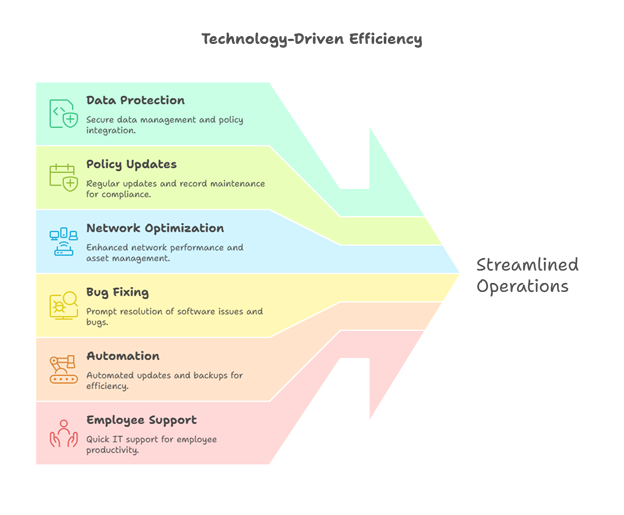
A variety of software programs, tools, and applications can be employed to keep a business up and running. Managing and updating them to ensure their compatibility within the workplace can be a tedious and complex task. With remote computer support services, these tasks are properly streamlined. Consulting a technology expert can simplify the following:
- Integrating data protection policies
- Updating policies and records
- Optimising networks, assets, data, and devices to function properly.
A dedicated computer support provider introduces a lot of benefits, such as:
- Fixing the bugs
- Automating software updates, security patches, and backups
- Eliminate tiresome manual work
- All technology-based assets remain efficiently managed.
- Even employees don’t need to wait for hours or days to resolve IT complications because they foresee and resolve the glitch before it becomes pronounced.
As the technical aspect is seamless, technical and automated tasks, like data entry, inventory management, scheduling meetings, or anything that aligns with technology, boost productivity.
3. Strengthening Cybersecurity and Enterprise Data Protection
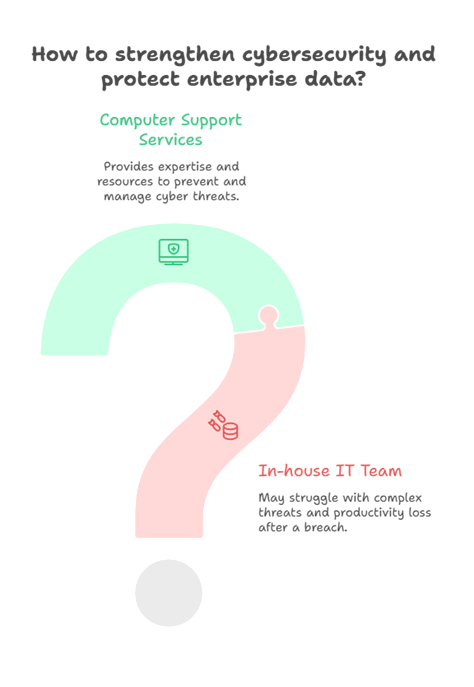
Cybersecurity remains at risk. It is a serious concern for businesses of all sizes. A small breach incident can cost a hefty amount for recovery. Moreover, it involves significant downtime, loss of sensitive records, and reputational damage. A non-technical or small-sized in-house IT team can hardly deal with the fallout of a breach. Simultaneously, their productivity suffers.
With qualified computer support teams in place, protecting sensitive business records from cyber threats can be possible. The IT support experts make rigorous decisions to install firewalls and antivirus software and introduce encryption for safe data transition to avoid vulnerability. If requested or needed, they provide technical training to educate on how to avoid phishing or malware attacks. Besides, they adhere to ongoing security audits.
Cybersecurity Ventures has observed and analysed the cost of technology compromises. It is likely to cost $10.5 trillion annually by 2025. To avoid such a huge monitoring loss, computer support services are essential. These services not only debug technical errors but also bring peace of mind.
4. Supporting Hybrid Work Models and Virtual Collaboration
The advent of remote work cultures or hybrid work models has expanded the dimensions of work areas. These days, employees are able to access critical systems and work in a shared environment effectively from remote locations. These technical arrangements are established with the help of computer support services. Without them, dots can appear in connectivity, data handling, and access to essential software.
These service providers can set up and maintain remote work systems or cloud infrastructure effortlessly. They can configure VPNs (Virtual Private Networks), cloud networks, and secure remote access. These settings are necessary for employees working from home or anywhere. These services are further expanded by troubleshooting connectivity issues and providing technical assistance to remote workforces.
All in all, these services make remote working seamless and accessible. The distance seems no longer a barrier between employees and businesses because they connect, collaborate, and maintain their productivity from where they are.
5. Empowering Employees with Technical Training & Help Desk Support
The commercial world comprises technical and non-technical employees. In other words, some non-technical staff members may not be fully proficient and comfortable working with certain tools or software. Navigating even meagre technical glitches can be challenging for them. It can significantly decline the quality, quantity, and speed of work.
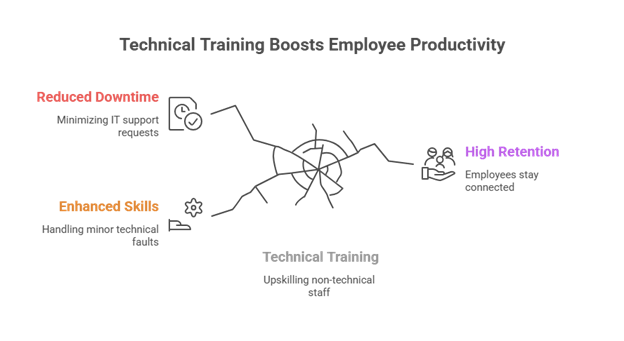
The computer service providers can provide technical upskilling or training if required. They can conduct it in groups or take one-on-one sessions to learn how to use specific software, troubleshoot common issues by themselves, and implement the best cybersecurity practices.
According to LinkedIn’s Workplace Learning Report, 94% of employees show their likelihood of staying connected with a company that provides learning, technical training, and development. This practice doubles the benefits of a company that registers enhanced productivity with a high employee retention rate.
In a nutshell, these services enhance technical skills and also empower non-technical staff members to handle minor technical faults independently. This practice certainly minimises the frequency of IT support requests and also downtime.
Moreover, these service providers help in-house teams to upskill and get well-versed with new tools, software features, and security protocols. These independent efforts pay off in the end, as your systems stay up-to-date and the team remains upskilled.
Conclusion
Computer support services have evolved to narrow down technical disruptions, streamline IT processes, and enhance cybersecurity. Also, remote work can be set up effortlessly. Since technology is advancing rapidly, these support providers help in upskilling the non-technical staff. They can be educated to tackle minor technical glitches independently through training. This is how a workplace can continue efficient production and a continuous flow of profit.