
Data extraction is powered by scraping information from niche websites or sources. Data surrounds us. Various applications and software on electronic devices like smartphones and laptops are deployed to automatically collect data for insights into user behaviour, investments, and likelihoods. This significantly highlights how crucial the data is.
This is why global corporations want it, expanding the horizons of their markets. Its market size was worth $2.73 billion in 2022 and is likely to hit $5.93 billion by 2029, with a compound annual growth rate of 11.9%, as per a report.
What is Data Extraction?
Data extraction is typically the automated process of retrieving a piece of information from unstructured sources, which can be websites, PDFs, reports, and databases. With advanced extraction methods, it is easy to consolidate, process, and refine the collected data so that it can be standardised and centralised for transformation on-site, in the cloud, or at a hybrid location. This process defines the very first stage of the crucial ETL (Extract, Transform, Load) process, which enables beneficiaries to transform raw data chunks into actionable strategies or insights.
Data Extraction and ETL
Scraping data is a foundational part of the ETL process. This process is crucial because it helps in collecting and consolidating datasets from a variety of sources into a specific location. Also, it takes in different types of records to convert them into a common format.
Considering the ETL process, it involves the following steps:
1. Extraction
The very first process is extraction, which means taking data from one or more sources to collect it in another location or system. It emphasises locating and identifying relevant datasets so that they can be prepared for processing or transformation. This process combines different records to be placed together for data mining or business intelligence.
2. Transformation
Transformation refers to refining the structure and quality of data toward an objective. It primarily focuses on the cleansing process, which helps in sorting, organising, and sanitising all records. Let’s say the cleansing process targets duplicate entries to be deleted and missing values to be added to enrich information. Overall, this process facilitates reliable, consistent, and usable data to be in place.
3. Loading
The third process does not involve complex or heavy technical processing but rather shifts high-quality data to a single and unified location. It can be data lakes & warehouses or the cloud, where an analyst can look into them to discover valuable strategies that prove to be realistically working and helpful.
Similarly, retailers such as Office Depot may be able to collect customer information through mobile apps, websites, and in-store transactions. But without a way to migrate and merge all of that data, its potential stays limited. Here again, data extraction is the key.
Data Scraping Use Cases
Multiple companies and organisations believe in pipeline automation, which circulates information for multiple uses online. Here are the top use cases:
- Market Research Firms: Various research companies, like Statista and Gartner, rely on extraction techniques to collect and analyse industry trends.
- Business Intelligence Companies: Companies involved in extraction and analysis services that develop business intelligence software and services like Tableau use extraction for data automation pipelines.
- Web Scraping Services: Some companies like Scrapy specifically deal in scraping projects, which require data for business purposes like price monitoring and lead generation.
- Cybersecurity Firms: Another interesting objective is security intelligence, which is achieved through this process. Also, companies like FireEye invest in it to overcome cyber threats.
- Social Media Monitoring Companies: Hootsuite-like companies rely on this process to monitor trends happening on social media platforms for online reputation building, understanding customer sentiments, etc.
- AI and Machine Learning Companies: This is the most crucial use case, as it involves companies like Google DeepMind. A company scrapes AI-ready data to improve, train their AI models, and derive intelligence.
Methods of Data Extraction
The wise use of technologies involves these powerful methods. Considering data extraction techniques or methods, these are the most recommended ones:
- Web Scraping Tools: It’s the simplest and fastest method. You just integrate your query and let tools like Octoparse automatically scrape data for you from desirable websites.
- APIs (Application Programming Interfaces): This involves scripting to define and interact with predefined endpoints to automate data pipelines for collection from applications.
- Database Queries: This method involves the use of SQL or similar languages to pull out data from any defined database.
- Data Crawling: Like a Google bot crawling into websites, this method refers to systematically scanning the target web data or sources for extraction.
- Screen scraping: This method captures and extracts the display output of any applications using some specialised tools.
- Text Parsing: It focuses on extracting text using natural language processing tools or algorithms.
- File Parsing: This method enables you to extract data from certain files, which can be CSV, XML, or JSON.
- Data Integration Tools: The extraction of data helps in developing data integration tools.
Benefits of the Extraction Tool
Various companies or organisations can resolve a variety of objectives through extraction because it eventually generates a database full of interesting statistics and facts. Not only that, but a statistic or fact might have some significant information that can be filtered out. Organisations can leverage these advantages:
- Access to Diverse Data Sources: A range of data sources can be targeted, including websites, databases, and applications. Later, this information can also be used for thinking innovatively to drive valuable strategies.
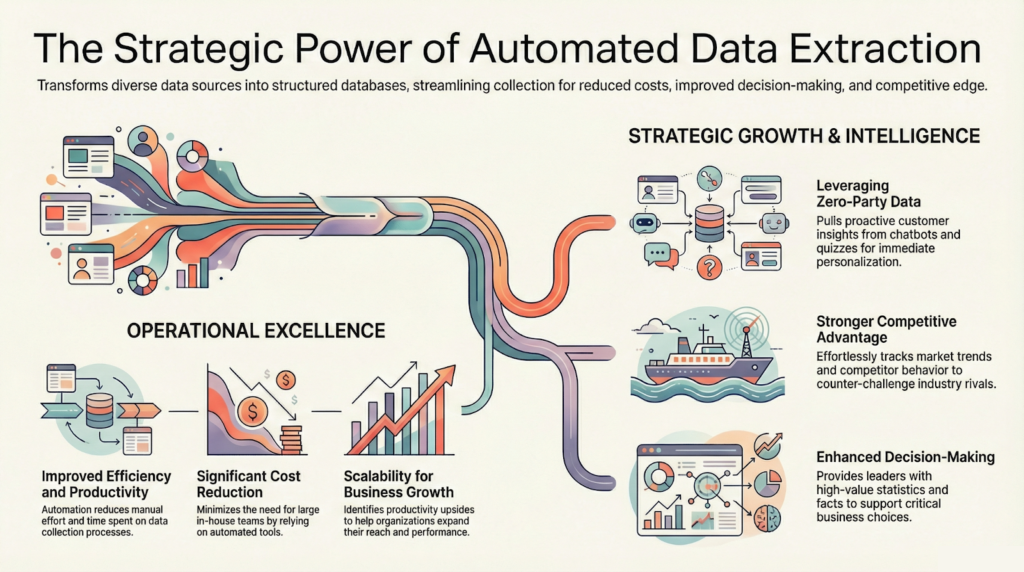
- Zero-Party Data: In 2026, zero-party data refers to the specific information that a customer intentionally and proactively shares with your brand, such as their personal preferences, purchase intentions, and desired communication style. Data extraction facilitates this by pulling these insights directly from interactive user touchpoints—like quizzes, preference centres, and chatbot conversations—into a centralised system for immediate personalisation.
- Enhanced Decision-Making: The extracted pieces of information carry valuable insights. An entrepreneur can also use it to support their decision-makers.
- Improved Efficiency: The very next advantage is improved efficiency. It involves automatic data collection processes, which eventually save time and reduce manual effort.
- Cost Reduction: A company relies more on tools for collecting data, which reduces the cost of hiring an in-house operations team.
- Data Consolidation: This process simplifies combining data from multiple sources so that a comprehensive overview can be taken.
- Facilitation of Data Analysis: Mainly, data scraping targets driving intelligence. This method helps in collecting a database for analytics and machine learning applications.
- Competitive Advantage: A brand effortlessly discovers market trends, customer behaviour, and competitors to counter-challenge them strongly.
- Customisable Extraction: If a company plans to introduce something new, scraped data helps in discovering the market trend and fixes to achieve a higher efficiency level.
- Scalability: Lastly, it presents the upsides of your productivity and growth, which businesses may discover and enhance to scale up their productivity and business reach.
Conclusion
Data extraction and scraping are technical processes that help in retrieving or collecting data for any business objective. It helps in achieving various objectives and benefits businesses eventually through the processing of the retrieved data.