
The world has gone crazy about AI, and unbelievably, artificial intelligence is worth it. The corporate landscape has shifted from manual management to a highly efficient, next-level hybrid management where human expertise meets automation. India is an ideal example where you see the fastest-growing market for virtual talent. It is sizing up, as the projected growth rate of 24.6% indicates, according to a source.
They work together to do some wonderful jobs. That’s why virtual assistant services are on the rise. They have built a multi-billion-dollar industry, which is worth $6.5 billion this year. So lean businesses! You have a wonderful time ahead, where scaling business is no longer in the hands of full-time employees. You have virtual assistants to do that job more efficiently and more affordably.
It’s not about money, but the value that virtual assistants create. Just imagine how affordable it is to only pay between $5 and $35 per hour for virtual assistant services remotely instead of bearing the overheads of $50K to $70K in-house in the U.S. for administrative roles. Overall, the operational cost comes down by up to 78% or even more. Internally, it will need the right tools to match this difference.
Core Communication and Collaboration Tools Ruling in 2026
Now, the first step to climbing the ladder of success is effective delegation, which starts with seamless communication. These days, standard tools have advanced AI infused to navigate gaps due to geographically dispersed teams. A few of these tools are:
Slack: It’s a wonderful tool that matches the industry standard for real-time messaging. It allows leveraging channels to sort topic-specific conversations.
Microsoft Teams: This amazing tool is for those who want multiple next-level features in a tool. This Microsoft 365 tool has the WhoBot that helps you to meet specialists and get specialised answers for internal company queries.
Zoom and Google Meet: These are two different tools for doing the same job. From video conferencing to real-time captioning, they bridge the gap by allowing interaction with international virtual assistant service providers.
Productivity and Time Management
Many companies outsource their non-core operations to save precious hours and money. When they hire a virtual assistant, they find it challenging to track output. It appears more difficult than tracking his presence. Many virtual assistant tools are trending to overcome this problem, and a few hot choices are here for you:
Time Doctor: It’s an automated time-tracking VA tool, which pauses when the computer notices no activity taking place. This ensures you only pay for actual work hours but not for leisure time.
Toggl Track: This simple tool has over 5 million users because it automatically maps remote teams’ log hours across different projects.
Clockify: This free tier for a basic time-tracking tool is gaining momentum, especially for startups that barely spend money on tracking tools initially.
Project Management and Workflow Automation
For any project, its timelines and coordination are crucial. To maintain them, you need a centralised tool that can act as a “source of truth”. Below, we bring a few of them for you:
Asana and Trello: These are two different tools for performing a virtual assistant role. They streamline tasks and track progress virtually through boards and lists.
Monday.com: This versatile tool aligns teams to collaborate harmoniously across complex workflows without hassles. So, it keeps remote teams in perfect sync.
Zapier: This AI tool has over 8000 integrated apps that excellently manage workflows with multiple steps or actions. For example, it can summarise enquiries or leads in Slack while drafting follow-up emails.
Professional-Grade Tools for Finance and Marketing
Modern VA tools can replace professionals by performing specialised roles like bookkeeping and social media management. Entrepreneurs hire them to leverage their capacity to share maximum niche workloads.
Accounting (QuickBooks, Xero, Zoho Books): These are a few cloud-based platforms that emerge as reliable virtual assistants that can generate flawless balance sheets, manage invoicing, and even monitor expenses remotely.
Design (Canva AI): You won’t feel a human graphic designer’s need with Canva AI, which can create professional social media graphics, posters, ads, and presentations without involving human beings.
Social Media VA Tools: With tools like Buffer and Hootsuite AI, you can align posts for a whole week together on platforms like LinkedIn. Also, they suggest how to optimise their posting times and hashtags for enhanced visibility and engagement.
How to Hire a Virtual Assistant in 2026
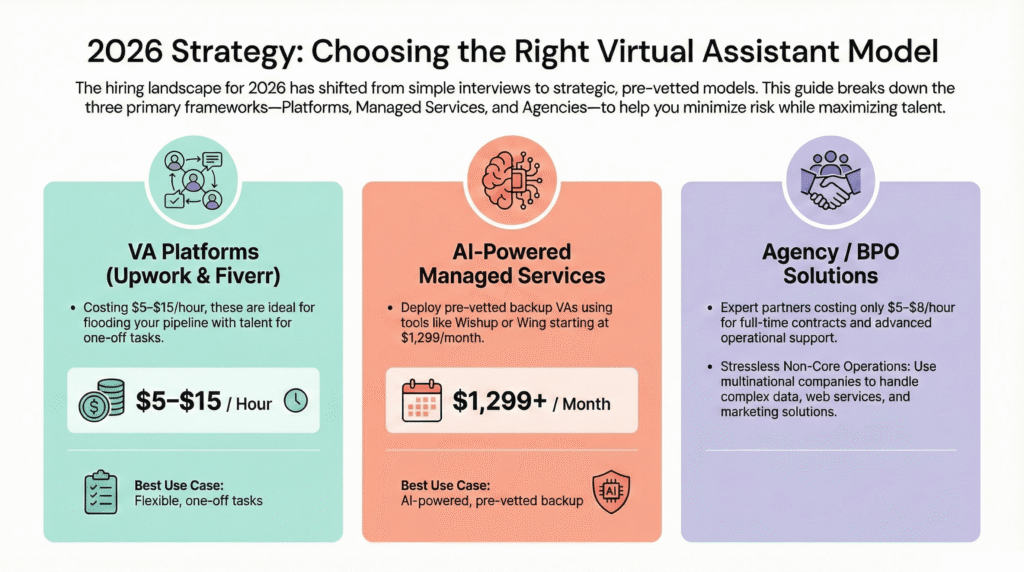
Onboarding is no longer a simple interview. It’s a logical strategy based on pre-vetted talent and managed services, so prospective risk will be minimal. Let’s share some popular hiring models available online that can be your ideal virtual hiring assistants.
VA Platforms: Being really affordable, platforms like Upwork and Fiverr can keep you flooded with a talent pool for one-off tasks. Moreover, they offer variable vetting options, ranging from $5 to $15/hour.
Managed Services (Wishup and Wing): Like freelance platforms, these are pre-vetted and AI-powered tools. So, you can deploy one of them as a backup VA that barely costs $1,299/month or onwards.
Agency / BPO: These are multinational companies offering full-time services for handling contracts, managed services, data solutions, web services, and marketing solutions. With just $5 to $8/hour, you can incorporate an expert partner with advanced tools for stressless non-core operations.
Hiring Process Checklist
Now that you have learnt what effective VA tools are available, you need to strategise where you need them most. So, here is the process to hire them:
Audit Needs: Discover the repetitive tasks, such as inbox management, CRM updates, emailing, etc., that consume 6-8 hours a day or 10-25 hours a week. These are some grey areas where a VA tool can do a wonderful job.
Define Budget: Now, you have a choice: either hire freelancers or use tools with a monthly premium for dedicated support.
Start with a Pilot Project: Align a pilot project to audit the candidate’s reliability and quality of work. Likewise, leverage a demo of the tool before paying or subscribing to it.
Onboard with Tools: Host a shared platform where your new hire can access projects to manage and communicate seamlessly.
Conclusion
The primary benefit of integrating virtual assistant services is to swiftly shift from traditional working methods to highly efficient, growth-focused advanced virtual assistant tools. Companies relying on these tools can see a 28-30% increase in their teams’ productivity. The delegating companies can maximise outcomes from their limited bandwidth by using it strategically. So, hiring a virtual assistant or leveraging AI tools as VAs indicates your progressive mindset and smart approach that builds a flexible and high-output engine for sustainability in the digital-first economy.