

Online businesses are kissing new heights. Every day brings new entrepreneurs on to the board of existing online businesses. Why should this trend not be prevalent? After all, it’s viable to reach out to global customers in a few clicks. Just a website is capable of catering to millions of worldwide customers or clients over the internet. The execution of this idea is unbelievably simple and cost-effective.
Key Benefits of SaaS CRM for Developers
Evolutions in the web development landscape are taking place now and then. Software as a service, or SaaS, is the greatest facilitation that the web developers have ever had. Let’s catch its round-up below.
The “Rent vs. Buy” Debate: Why is SaaS Winning?
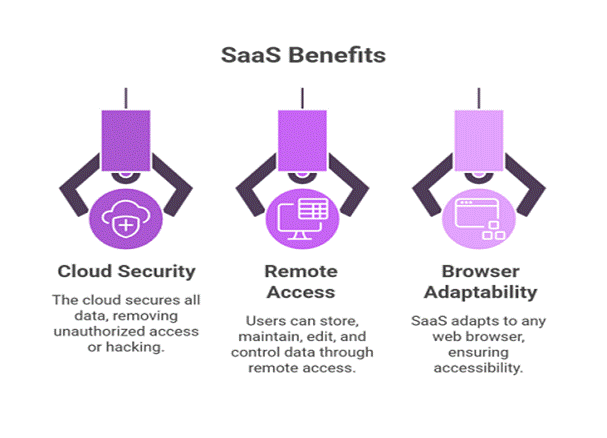
It is an outstanding service for borrowing full-fledged software of your niche over the internet. The entrepreneur can subscribe for this paid service anytime from the expert SaaS dealers. The cloud secures all his data, which removes any possibility of unauthorised access or hacking.
It’s pretty much similar to accommodating a house on rent. The user can store, maintain, edit and control his data through remote access. In return, he pays. And the best part is its ability to adapt to any web browser.
Developers Quitting Traditional CRM Installs
If you think that website development can cost an arm & a leg, SaaS is the best substitute you would have. This is why most of the small & medium-scale industrialists love to linger on this service for hitting the bull’s-eye (their business goal) seamlessly. From the perspective of a developer, SaaS CRM significantly eliminates the need for complex database architectures from scratch while boosting project viability. This option also introduces pre-built APIs and managed services, which saves over 40 hours of manual coding for developers. So, they leverage this facility while enhancing front-end user experience and customer-friendly features.
It means that the client claims the wholesome right to procure it as if he/she were its owner. Flexibility in cost, its maintenance and deployment along with remote access entitle it to the foremost position in the context of business software. No infrastructure cost & manpower would be required if it were acquired.
You need to revamp the installed software to get off the chances of a cyberattack. The subscribing organisation frequently installs its update. With it, there is no such sword that lurks. Even you can catch a backup whenever you require.
Suppose an organisation subscribed to CRM SaaS rather than hiring web development in its native Gold Coast. When the servicing organisation upgraded it, the subscriber lost a bit of CRM data. In the meantime, the subscriber accessed the backup to restore the lost data. Moreover, the cost of re-installing the backup as well as upgrading was included in monthly charges.
At times, the subscriber requires more space to accommodate mounting CRM data. Rather than bearing the additional cost of space requests, testing, changing IT architecture & software installation, a SaaS alternative provides an agile and elastic infrastructure that automatically ramps up with your data volumes. Going for this service is a brainy deal because you must decide whether you want flexibility in your web application to manage sudden inflation in the traffic. And this service offers this value.
Easy Ways SaaS CRM Supercharges Your Web Projects
The SaaS CRM has potential to get integrated with the existing software of the particular niche. Its integrity enhances its viability in the business scenario. Therefore, it is a wise idea to look into these key points before integrating it for enhancing your web development. viability:
Integration of layout: SaaS requires data transmission. It identifies the transfer of sensitive data ‘outside the security wall of the local network’ to the logical infrastructure. Thereby, the data gets access to such components that would work together.
The SaaS application channelises the existing data from on-premise resources to the brand-new data warehouse. It includes:
- Bootstrapping of this application with the existing CRM data of the client.
- Its configuration with the on-premise CRM so that the interlinking of the local source and the distant virtual location can be established. For example, a SaaS application integrates placed orders in the eCommerce CRM whenever they are flown in.
- Configuration of on-premise CRM software so that the linked SaaS application can serve business purposes jointly and accordingly. For example, the data from the on-premise payroll application can be transferred & integrated with the SaaS application.
These integrations are essential for aligning data from both sources to sync. It enables smooth processing of data of any size.
Integration broker: Deploying and integrating SaaS is not enough. Its viability is essential. The on-premise application and the SaaS application are configured for interoperability. But without an integration broker, both applications will not be active. For it, both must be melted out together for groundbreaking data management services.
An integration broker, such as Zapier, Mulesoft, etc., makes sure that the SaaS and on-premise applications recognise each other’s functionality. It helps to fine-tune the business environment as well. Each business has its own niche and diverse landscape. Taking this fact into account, this broker is designed as customisable. Its integrity can also be tailored to route functions of both resources.
In a nutshell, the integration broker is a meeting point where a local application gets meshed up with far-located SaaS software. As it can be moulded, the user can set up desirable modules or remove them as per requirement. Through this tunnel, the exchange of data takes place between the foretold sources. Among various functions, these are the prominent areas in which it does great work:
- Security: Since hacking is at an upsurge, security concerns have come to the mainstream. Upskilled SaaS CRM providers navigate these challenges by maintaining SOC 2 standards with end-to-end encryption for the data at rest and in transit. Therefore, the incoming data has to funnel out from taut security modules. These modules include authentication of resources, decryption, scrutinising decrypted data and so on. Since both applications follow different security guidelines, it is essential to bring both into coordination to secure access.
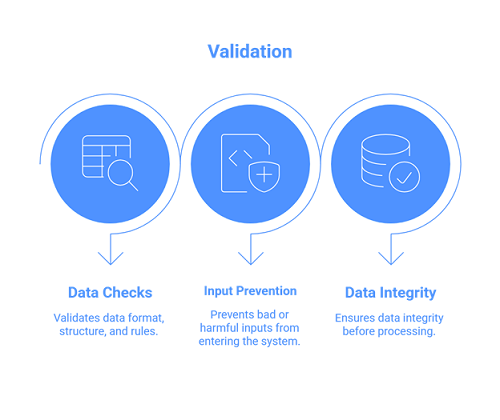
- Validation: Validation verifies the accessibility. It compares the data from both sources and then filters out the compliant data sets. While doing so, the data is formatted in a comprehensive manner.
- Synchronisation: It stands for orchestrating what kind of data in which order. This process employs logical comparisons to sift through data from both sources without compromising their consistency.
- Routing: It’s the final step that channels the processed data to the final destination. If it requires it, it also runs on logical ways to determine the final warehouse of the processed data.
Conclusion
SaaS integration is a vast concept. Its CRM is the superior choice for upskilled web developers that look for modern web development viability. This post has explained everything related to its integration broker, data synchronisation, and cloud security protocols (authentication and decryption) without breaking the bank.